Activity No.1
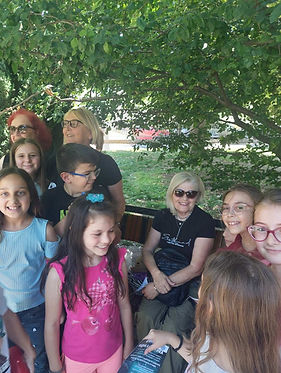
The “WAVES” project has begun: Students have entered the world of sound!
As part of the “WAVES – Aquatic Acoustics, Vibrations and Environmental Sound” project, the first educational workshop for young researchers was held.
What did we learn at the first meeting?
Through presentations and practical experiments, students discovered how sound is created through vibrations and how it travels through air, water and solid objects. Of particular interest was the fact that sound travels faster through water, which is crucial for the communication of marine animals such as dolphins.
Why is this important?
In addition to the basics of acoustics, we also talked about ecology – that is, how excessive noise (Noise pollution) affects living things. This workshop is just the beginning and foundation for our future research on the aquatic environment.
We are ready for the next challenges! Follow us for more news from the “WAVES” project.


Activity No.2
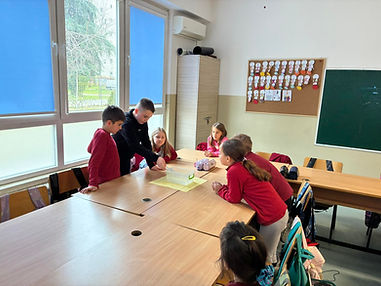
Experimenting with Sound: How Do Vibrations Travel Through Water?
As part of the "WAVES" project, our third-graders turned into young scientists! Instead of just listening to theory, they took part in an exciting activity – exploring sound through an experiment with metal forks and water.
What did we investigate? Through a simple yet effective test using forks and a glass of water, the students saw firsthand how vibrations are created. They concluded that:
-
Sound is the result of vibrations.
-
Water is an excellent "conductor" of sound because its particles transmit waves much faster.
Science through play . This activity helped us understand how dolphins communicate over long distances underwater, but also why it is vital to protect the aquatic environment from noise pollution.
Through these hands-on activities, science becomes easy, fun, and unforgettable!



Activity No.3
Exploring Beneath the Surface: Aquatic Life in Our Local Rivers
As part of the "WAVES" project, our third-graders joined forces with more experienced sixth-graders to become true young ecologists and researchers! Through digital technology and teamwork, they explored the rich plant and animal life thriving in our nearby rivers.
What did we investigate? Using the internet and various digital resources, the students created wonderful posters and presentations. Through this research, they discovered:
-
Which plants and animals are the most common inhabitants of our local rivers and what their unique characteristics are.
-
How river biodiversity reacts to environmental changes and pollution.
Connecting with the real world. This activity helped students realize that nature is not just a textbook lesson — they connected their new knowledge with the very rivers they see every day. They learned that clean water means life for all of us and that all aquatic organisms depend on our responsible behavior.
Through this cross-generational collaboration, we developed strong research skills and raised ecological awareness to protect our waters!


Activity No.4
The Sound of Silence: How Noise Pollution Affects Aquatic Life
In our fourth "WAVES" workshop, our third and sixth-graders stepped into the shoes—or rather, the fins—of aquatic animals! Through a unique sensory experiment, our young scientists explored the invisible threat of noise pollution caused by human activities like shipping, traffic, and construction.
What did we investigate? During an immersive listening activity, students closed their eyes and experienced the sounds of ship engines, sirens, racing cars, and heavy machinery. Acting as different marine animals, they experienced firsthand how intense noise impacts underwater life, concluding that:
-
Noise pollution creates a disruptive environment that causes stress and confusion for aquatic animals.
-
Underwater noise directly interferes with how marine life communicates, navigates, and finds food.
Connecting with the real world. This hands-on empathy exercise helped students look at our rivers and seas from a completely new perspective. They realized that keeping our waters healthy means more than just keeping them clean from plastic; it also means protecting the natural acoustic environment so that underwater life can thrive in peace.By blending science with empathy, our students developed a deeper sense of environmental responsibility and a stronger commitment to preserving our quiet, natural ecosystems!


Activity No.5
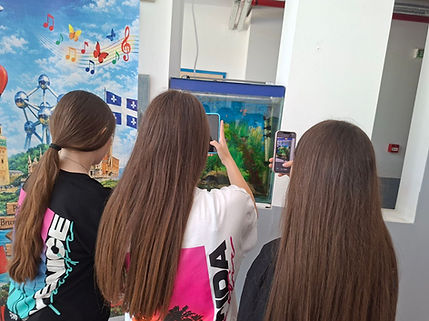
Today, students had the opportunity to explore aquatic life in the aquarium using the Seek app. By observing and identifying different fish species, they developed their research skills, curiosity, and appreciation for nature.Combining technology with hands-on learning made this activity both engaging and educational.


Activity No.6
Quieter Cities, Cleaner Planet
Our 6th Graders Tackle Transport Noise and Carbon Footprint! As part of our ongoing "WAVES" project, our sixth-grade students recently participated in an exciting, hands-on workshop focused on a major modern challenge: achieving carbon neutrality by understanding the link between traffic noise and environmental pollution. Here is how our young eco-researchers connected science with real-world action: The Noise & Carbon Connection: Through an engaging introductory discussion, students learned that vehicles emitting harmful gases (CO_2) are also the main source of city noise. They concluded that areas with the highest traffic noise levels usually suffer from the highest air pollution. The Matching Game: Working in pairs, students played a logical association game. They matched everyday activities (like riding a bike, driving a diesel car, or using an electric scooter) with cards showing both the CO_2 emissions and the noise levels in decibels (dB) they generate. Digital Carbon Calculators: Putting technology to work, students used a digital Carbon Footprint Calculator on their smartphones and computers. By entering their daily travel habits, they calculated their personal impact in tons of CO_2. The Big Realization
Our students clearly saw that eco-friendly transport choices like walking or cycling produce zero CO_2 and zero noise, making them the perfect solution for a quieter, healthier, and carbon-neutral future! We are incredibly proud of our students for developing their digital skills and raising awareness about how our daily transport choices can protect both our local community and the planet! #WAVESProject #CarbonNeutrality #EcoEducation #GreenFuture #NoisePollution


Field Research
Listening to the Voice of the Treska River with a Hydrophone!
As part of the "WAVES" project, our students stepped out of the classroom and headed to the banks of the Treska River for an exciting field trip. This time, they had the rare opportunity to act as real oceanographers and researchers, using specialized equipment—a hydrophone (underwater microphone)—to "listen" to the world beneath the surface.
What did we discover underwater? Lowering the hydrophone into the waters of Treska, the students eagerly put on their headphones and, for the very first time, heard the hidden sounds of the river. Through this hands-on measurement, they:
-
Recorded the natural flow of the water, the movement of river pebbles, and underwater currents.
-
Learned how sound intensity is measured in an aquatic environment and how sound waves travel through water.
-
Concluded how vital it is to preserve the river's natural peace and prevent artificial noise from disrupting aquatic habitats.
This unforgettable adventure on the Treska River showed our students that science is at its best when experienced out in nature!


Field Hydrophone Measurements on the Vardar River
As part of the “Waves” project, a field measurement was carried out on the waters of the Vardar River using a hydrophone. Students had the opportunity to directly explore the river’s acoustic environment by recording underwater sound signals. This hands-on experience helped them better understand sound propagation in water while strengthening their research and scientific skills.


Collaborative Creative Workshop: "The Voice of the Underwater World"
As part of the "Waves" project, an inspiring and educational workshop was held, bringing together students and their parents to raise environmental awareness about underwater noise pollution. The highlight of the event was the creation of a collaborative collage poster showcasing the richness and diversity of marine life.
Through drawings, creative messages, and teamwork, the participants demonstrated how human-generated noise affects marine organisms and why it is essential to protect our waters. This activity strengthened the partnership between the school, parents, and the wider community, reinforcing their shared commitment to a greener and more sustainable future.


Environmental Awareness Campaign: Sharing Knowledge About the Underwater World!
Our dedicated students took on the role of young environmental ambassadors! As part of the "Waves" project, the children created educational leaflets and personally distributed them within the local community. Through this initiative, they engaged with citizens, explained how underwater noise pollution affects fish and other aquatic life, and delivered a powerful message about the importance of preserving the peace and quiet of our rivers and seas.
We are proud of their dedication, enthusiasm, and commitment to protecting the environment!